Soul Coughing went straight from a Bowery club night to a Warner-distributed major label, skipping the indie single and EP stage entirely. Ruby Vroom came out September 27, 1994.
The Signing
The A&R man was Randall "Randy" Kaye of Slash Records, and he found them by accident. Doughty told a reporter in October 1994 that Kaye had come to see Boss Hog at CBGBs, couldn't get in, wandered next door to CB's Gallery for a coffee, and walked into a Soul Coughing set. Doughty joked that the band owed its whole career to Boss Hog's popularity. The deal was done in 1993, after the band sorted through a few offers. Steinberg told Rolling Stone in 1996 he had chased contracts for years before joining and could hardly believe it when offers started arriving. They had picked up management along the way, too: the early credits list Jim Grant and Seriously, Inc.1
Steinberg remembered it as a hype storm. He told the Michigan Daily in March 1995 that for a while nearly every A&R person in the business wanted a meeting, and that the labels came to the band, pulled in by the live shows. His own commitment deepened when he happened to hear one of the band's tapes at a friend's apartment and was knocked out by the grooves.2
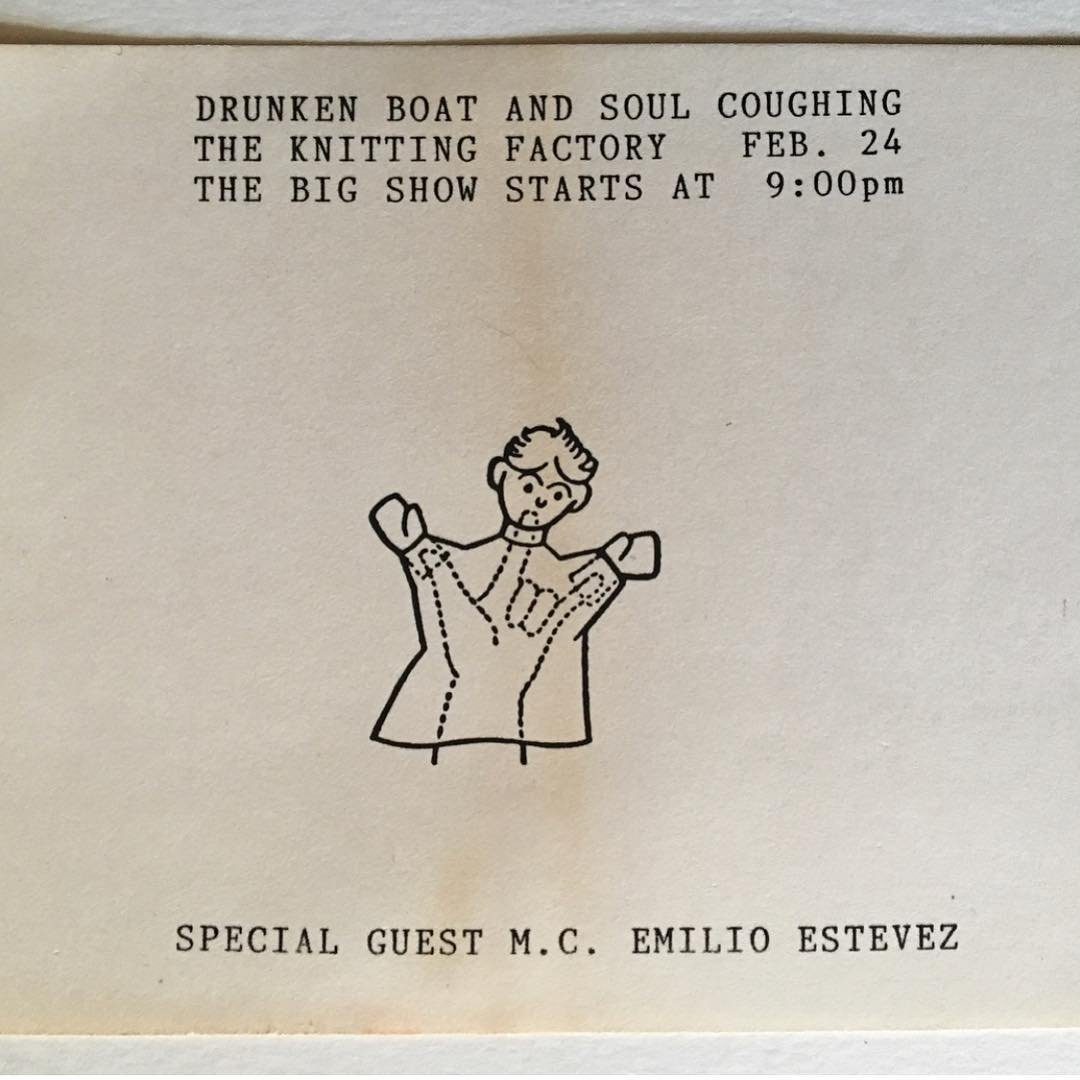
Degli Antoni later said the band had other offers, from Columbia, Caroline, Atlantic and Imago. They chose Slash because it was an independent distributed by Warner in North America and London/Polygram overseas, and they trusted it to leave the records alone while still backing them. Asked what caught the labels' attention, he credited Gabay: at early shows you could barely hear the keyboard player, only sometimes the upright bass and the blond guy waving his hands, but the drummer would not quit.
Making the Record
Ruby Vroom was tracked April to June 1994 at Sunset Sound Factory in Hollywood with Tchad Blake producing, recording and mixing. Blake and Mitchell Froom used that room as home base, and a storage closet off the lounge was packed with vintage keyboards and road cases of toys: whistles, rattles, toy xylophones. Plenty of it made the record, including a train whistle Doughty blows on "Uh, Zoom Zip."
Blake came to the project through two routes. While the band was weighing label offers, they had reached out to him through David Kahne while a Columbia deal was under consideration; nothing came of that when the deal fell through. Once they signed with Slash, co-founder Bob Biggs, who already knew Blake's work, called him directly.3
Blake wasn't the only name on the list. Steinberg said the band interviewed several producers before settling on him, and that what won them over was his knack for catching a moment, which suited a band that wanted its live sound on tape.2
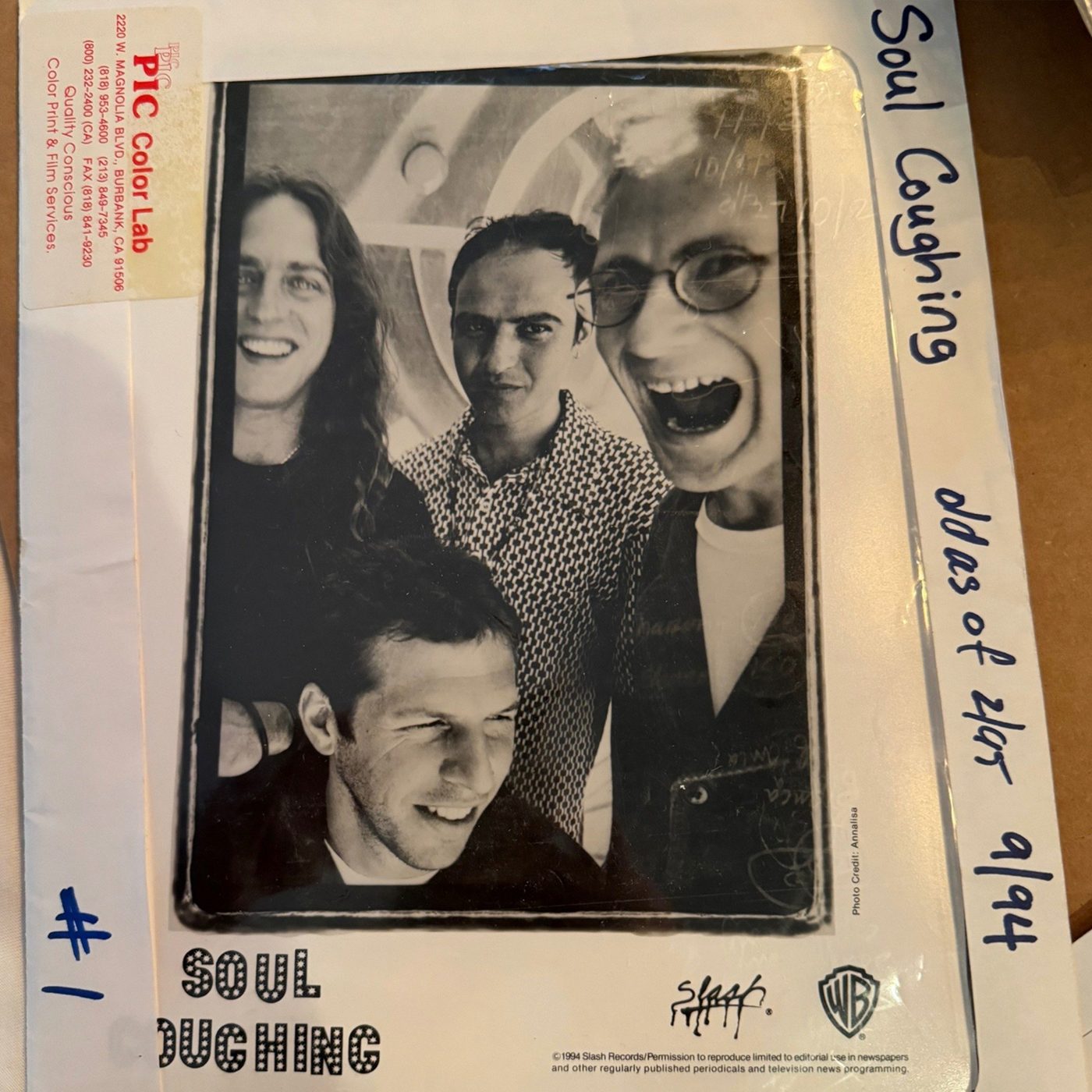
Blake's methods were as unorthodox as the band. Per Wikipedia's account he put a binaural dummy-head microphone in front of Gabay's kit, mounted a mic inside a car muffler (nicknamed "the Bone") in the drum booth, and had Doughty scream ad-libs on "Casiotone Nation" through an Ahuja bullhorn-on-a-stick PA Blake had bought in India.4
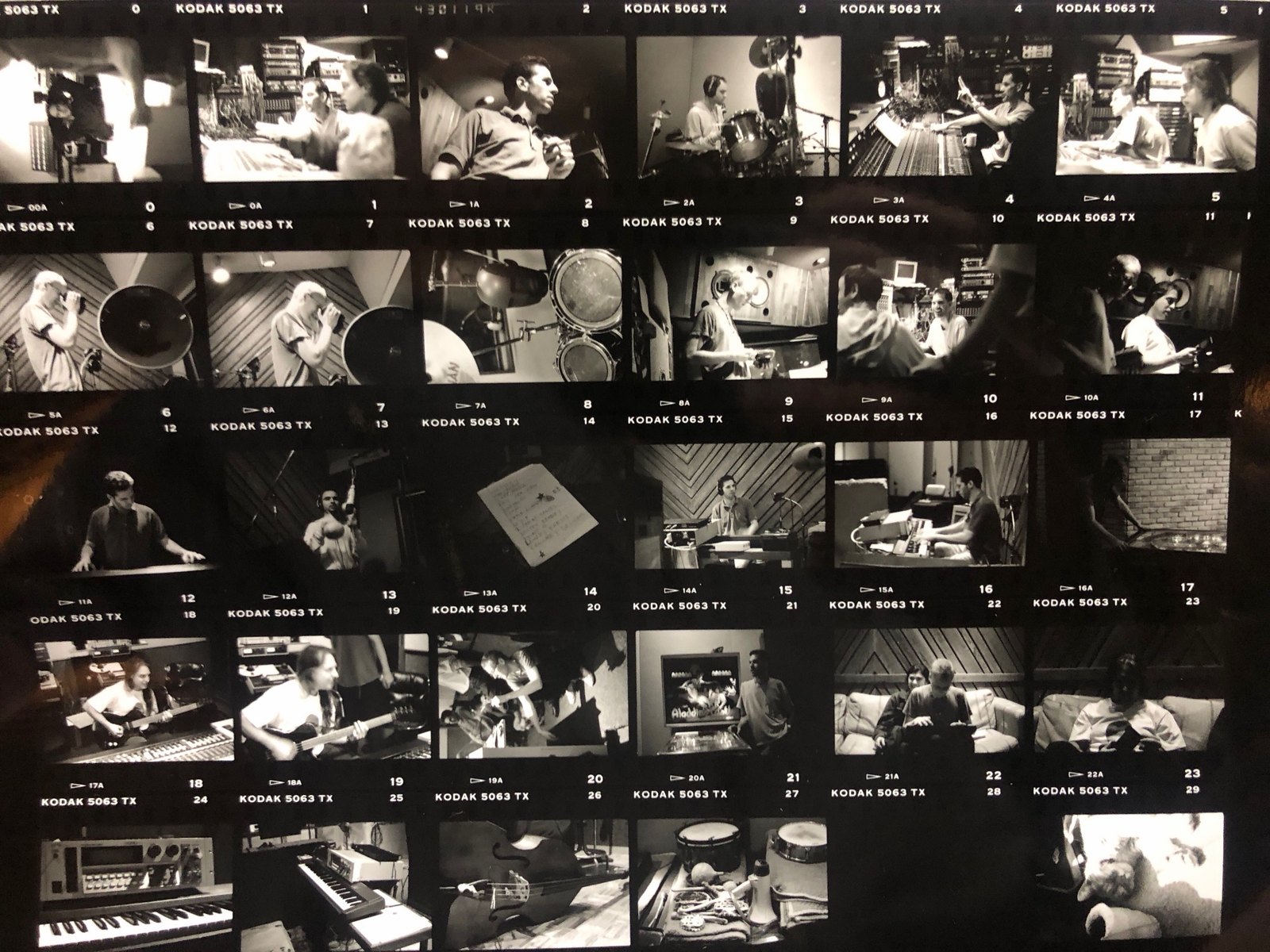
Blake filled in the rest himself in a 2007 Gearspace Q&A. The record was tracked and mixed in 29 days in Sound Factory's Studio B, still his favorite tracking room, on a 1970s API desk, and it was mostly cut live, with some keyboards, vocals and guitar overdubbed later. The drums went in Studio B's tiny vocal booth, which he said was a big part of his drum sound on every record he made from 1986 to 1998, with the Neumann dummy head as the overhead and a mono mic buried between the kick and snare, squashed through a Level Loc. Steinberg's bass ran through a SansAmp, a tube U47 and dbx 160s, which Blake said brought out the growl Steinberg plays with. On degli Antoni he kept it short: "That's Mark. What more can I say." And Doughty, he said, is such a characterful singer that the mic hardly mattered.5
The same Q&A goes deeper for anyone who wants the details. The booth was just big enough for a medium kit, and the drummer had to be fairly agile to climb back out. Asked how he got the long, 808-like kick on the record, Blake said he couldn't remember exactly, but it would have had SansAmp on it, and it may have been a little red Remo student kick, 18 or 20 inches, that tends to sound that way. The overheads got a second copy run hard through Spectrasonics 610 compressors and blended in under the clean signal, the mono kit mic sometimes went through an MXR flanger pedal to shake up its tone, and the keyboards may have had a touch of a Hughes SRS AK-100, a consumer stereo enhancer he was fond of. When he got to the bass chain he asked John Paterno, who was reading along, to help him remember. He described the Ahuja too: a small, cheap PA from New Delhi with an 18-inch horn and an amp head with a cassette deck built in, bought new with a delay and three mics for about $150. And he mentioned that Doughty sang "The Bunny" on Mitchell Froom's solo album Dopamine through a D112, a mic that usually lives inside a kick drum.5
Blake never changed his mind about the room. Back in Studio B in 2005 to make a Bonnie Raitt record, he told Mix it was the best-sounding room he had ever worked in.6
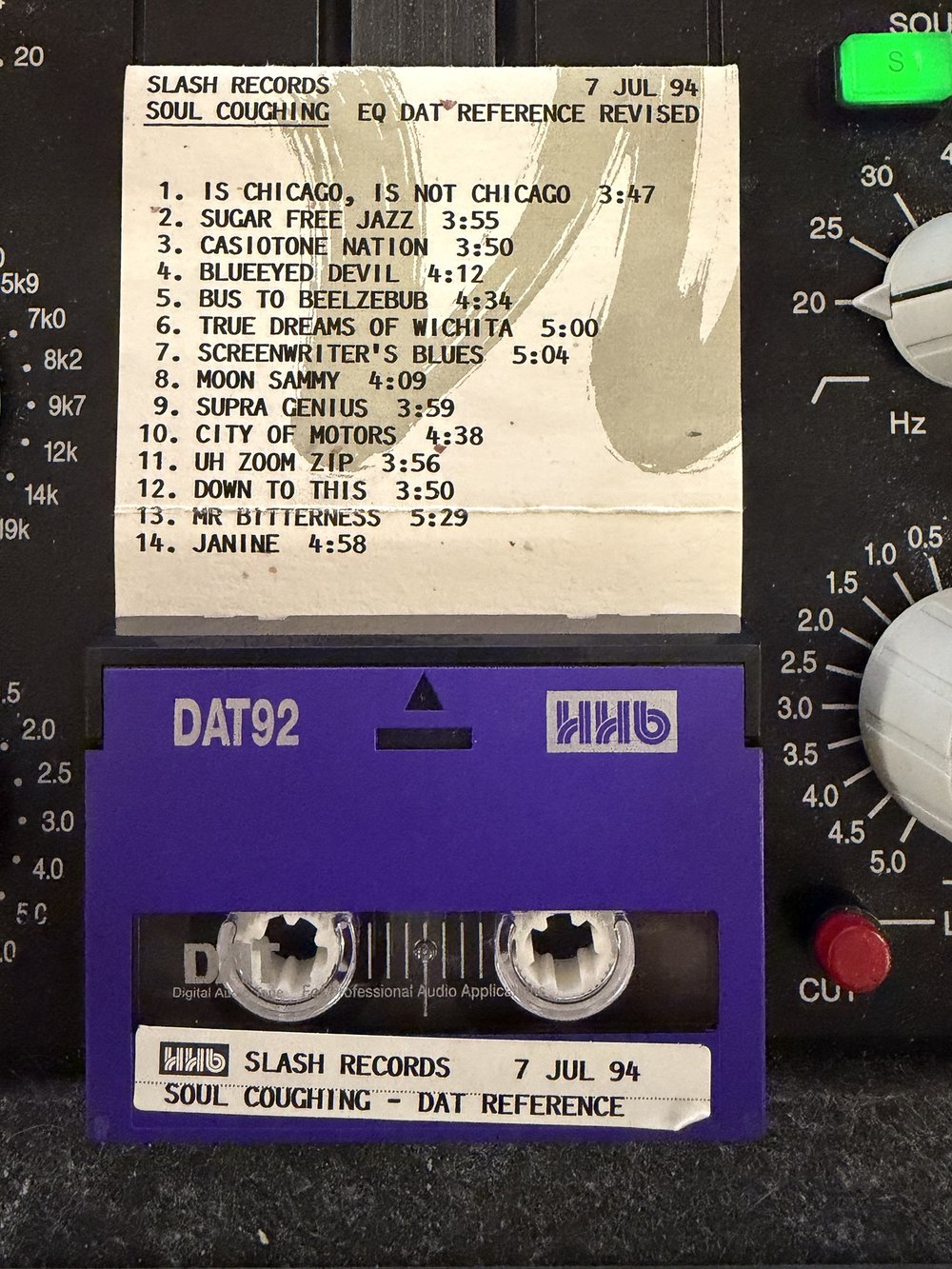
Once the mixes were done, the record went off to be mastered. A DAT labeled "Soul Coughing EQ DAT Reference Revised," from Slash Records and dated July 7, 1994, holds all fourteen songs in the album's running order, "Is Chicago, Is Not Chicago" (3:47) through "Janine" (4:58). The word "Revised" means there was at least one earlier version. That was two months before the album came out, and a little over a week after the session credits end in June.
The CD credits date the sessions "April and June 1994," which points to two blocks of work rather than one straight run. John Paterno was the second engineer, credited as "Second Engineered With Much Girth."7 Blake said as much in a July 1994 radio interview, two months before the release: "There may be, you know, one small overdub or something on there, but most of it is live."3 For all its studio sheen, the Houston Press reported in 1996, about 95 percent of the album was cut live.8 A year after the sessions Doughty was still raving about Blake to Denver's Westword, especially what he did with the stereo field and the sonic spectrum.9
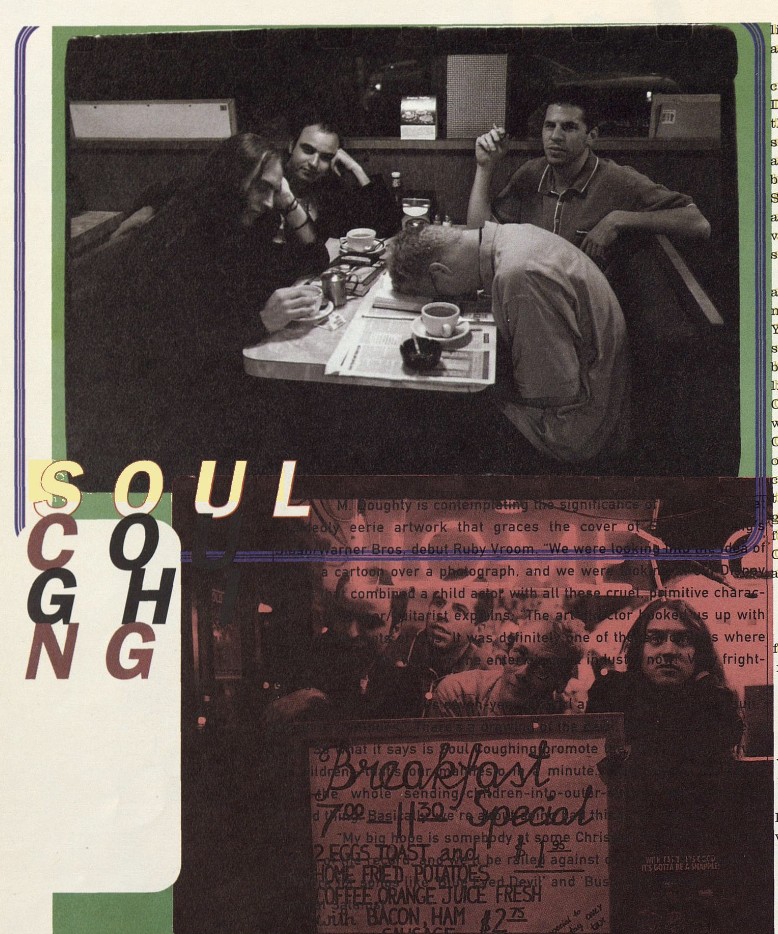
Ray Gun wrote the band up that December with a diner shoot, M. Doughty face down on the table. The piece also gets into how the cover came together, including the idea of putting a cartoon over a photograph.10
The only guest is Rachel Benbow Murdy, Doughty's ex-girlfriend. A year before the sessions she had gone to a payphone in Sheridan Square and sung "Lemon Tree" with an improvised melody into their answering machine. Doughty and Steinberg then recorded the tune at the Knitting Factory during the daytime with house engineer James McClean, who put a mic on the answering machine. That became "Janine."
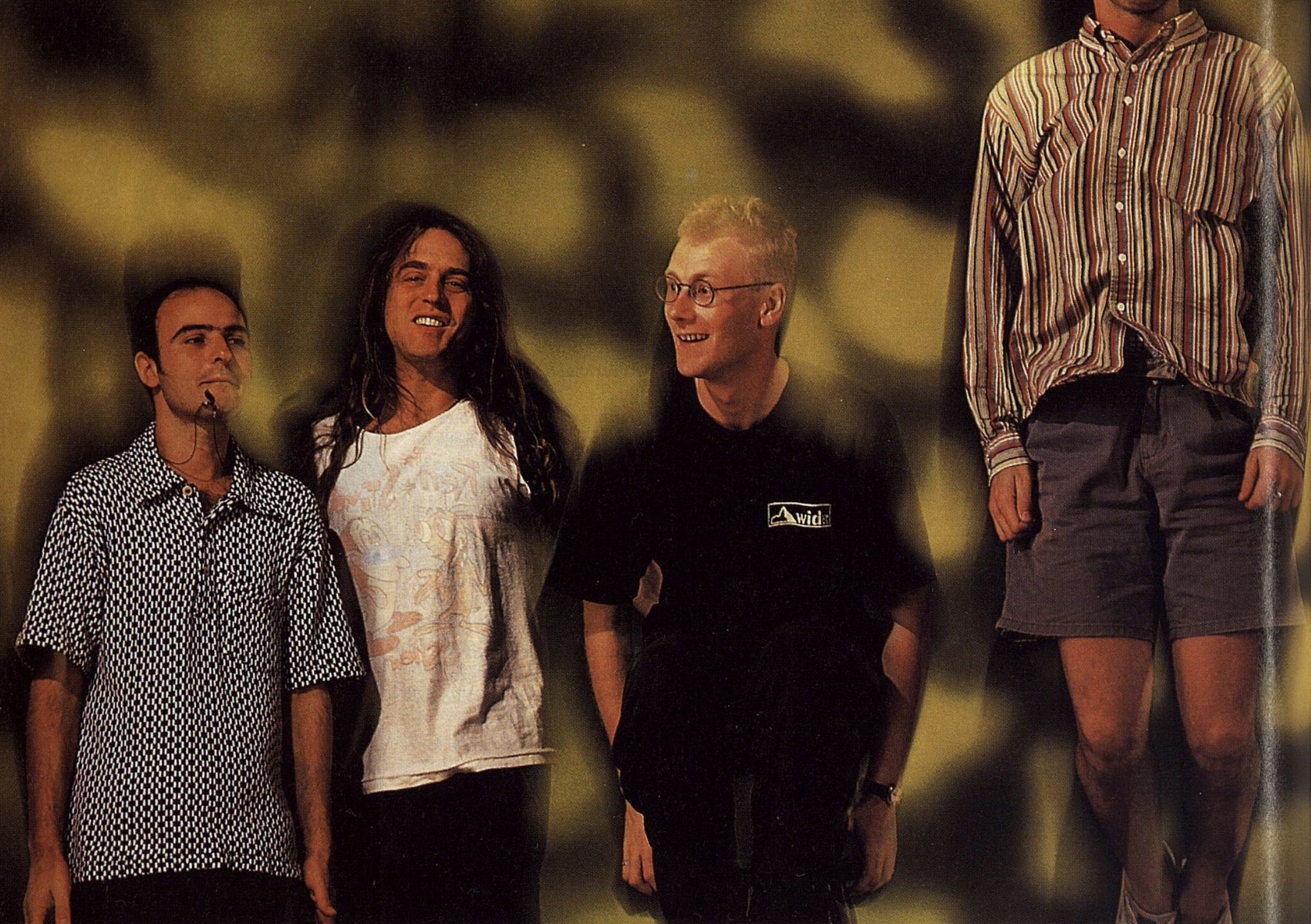
The liner notes nod to Saskatoon, and Doughty said two Canadian friends from Guelph, living in the East Village, heard the finished record first. The whole thing, he said, was "trip-tested to Canadians."11
Steinberg later called the album a postcard from New York, even though it was made in Hollywood, and thought it was funny that Irresistible Bliss, cut in New York, ended up less about the city.12
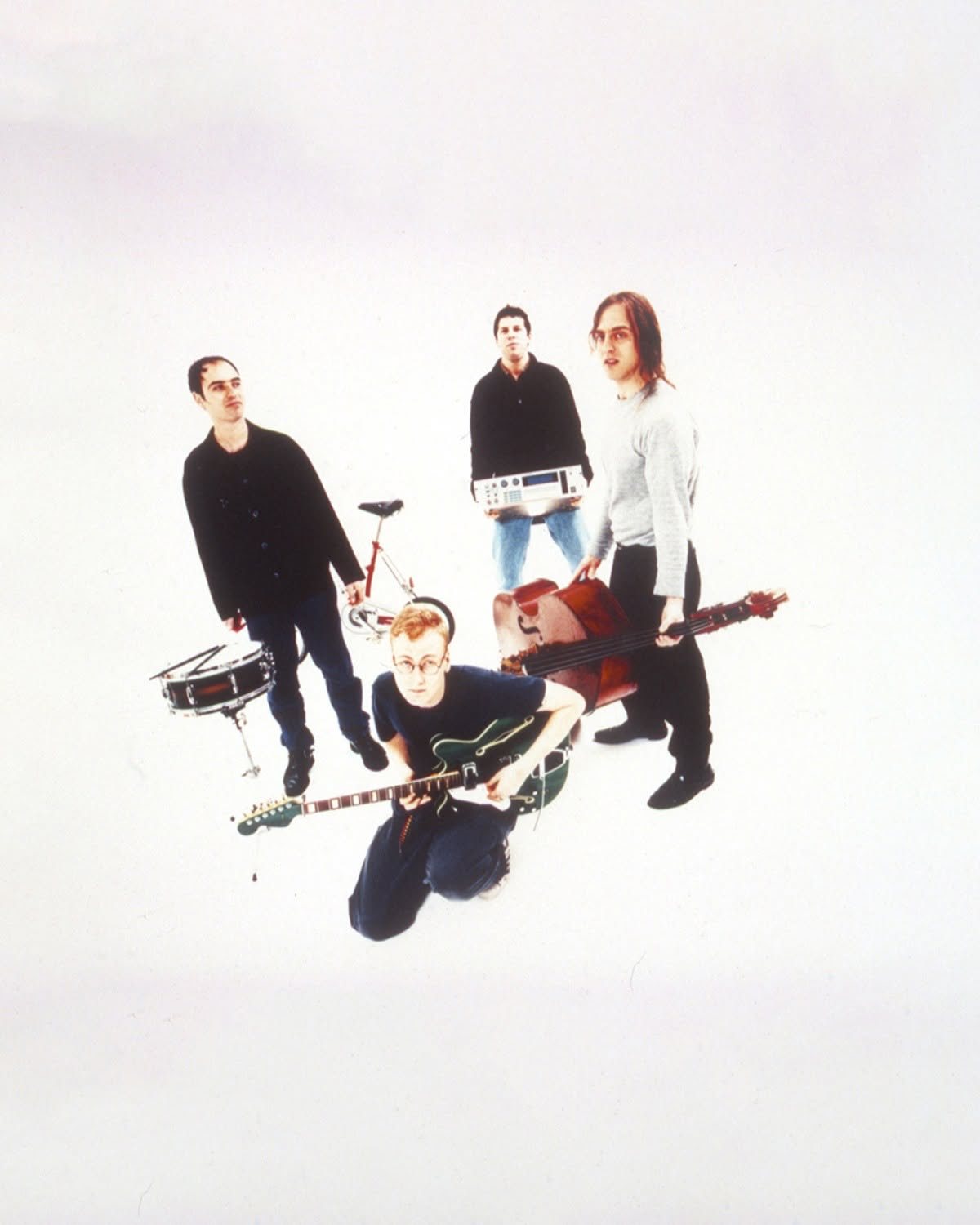
Option's September 1994 issue, just ahead of the album, ran a profile of the band with this photo.13
The Roughs
Rough mixes dated May 4, 1994, show what the band actually cut at Sound Factory: 18 songs, 19 takes. Thirteen made the album. The one album track missing is "Janine," which fits, since it was put together separately at the Knitting Factory around the answering-machine tape.
The other five stayed in the can for a while. "Murder of Lawyers," "Buddha Rhubarb Butter," "I'm Living on Baby Food" and "Theme from Rachel's Sitcom" turned up over the years on promos, compilations and finally the 30th anniversary edition. "Disseminated" is the odd one out. It's the only song on the roughs with two takes, and it was held back entirely, then recut for Irresistible Bliss two years later.14
The timing fits the credits, too. With tracking in April and mixing in June, the roughs look like the band's take-home tape from the gap in between.
The Samples
Degli Antoni's sampler is the record's signature. "Bus to Beelzebub" rides a long loop of Raymond Scott's "Powerhouse," and "Uh, Zoom Zip" borrows from Scott's "At an Arabian House Party" along with A Tribe Called Quest's "Jazz (We've Got)" and Bobby McFerrin's cover of "Opportunity." "Down to This" pulls from Toots and the Maytals' "Time Tough," Howlin' Wolf's "Smokestack Lightning," the Roches, and the Andrews Sisters' "Don't Sit Under the Apple Tree," whose chorus took some real legal wrangling to clear.15 "Blueeyed Devil" grabs Benny Goodman's "Clarinet a la King," and Erroll Garner's "Don't Be That Way" turns up in both "Sugar Free Jazz" and "Mr. Bitterness."16 Not everything borrowed was a sample: on "Casiotone Nation," Doughty works a few words from Fugazi's "Waiting Room" into the lyric. "Screenwriter's Blues" loops degli Antoni's own orchestral horn writing. Elsewhere the band quotes the Courageous Cat theme and Monk's "Misterioso." Degli Antoni told SCUG in 1996 that he had also lifted Tori Amos's voice from her "Smells Like Teen Spirit" cover for "City of Motors" and "Mr. Bitterness," bragged about it publicly, and never got caught.17
Doughty explained "Is Chicago, Is Not Chicago" in a 1995 SonicNet chat: he was tripping in Chicago and it struck him that everything outside his body was Chicago and everything inside was not. (Someone on a Usenet group then accused him of lifting the idea from Descartes.) He also confirmed a backward message hidden at the end of "Uh, Zoom Zip" that he had forgotten about until he relistened.1819
The Title
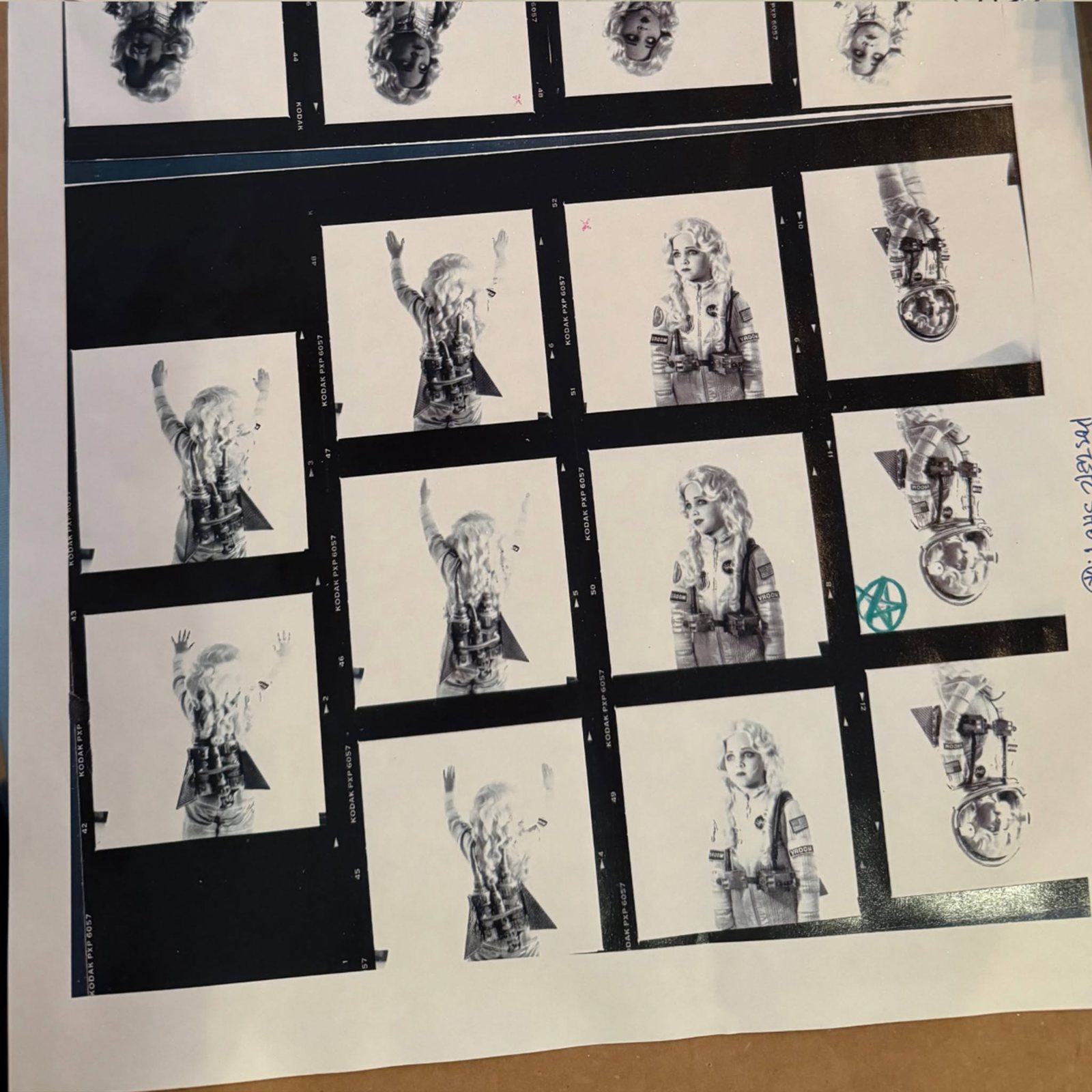
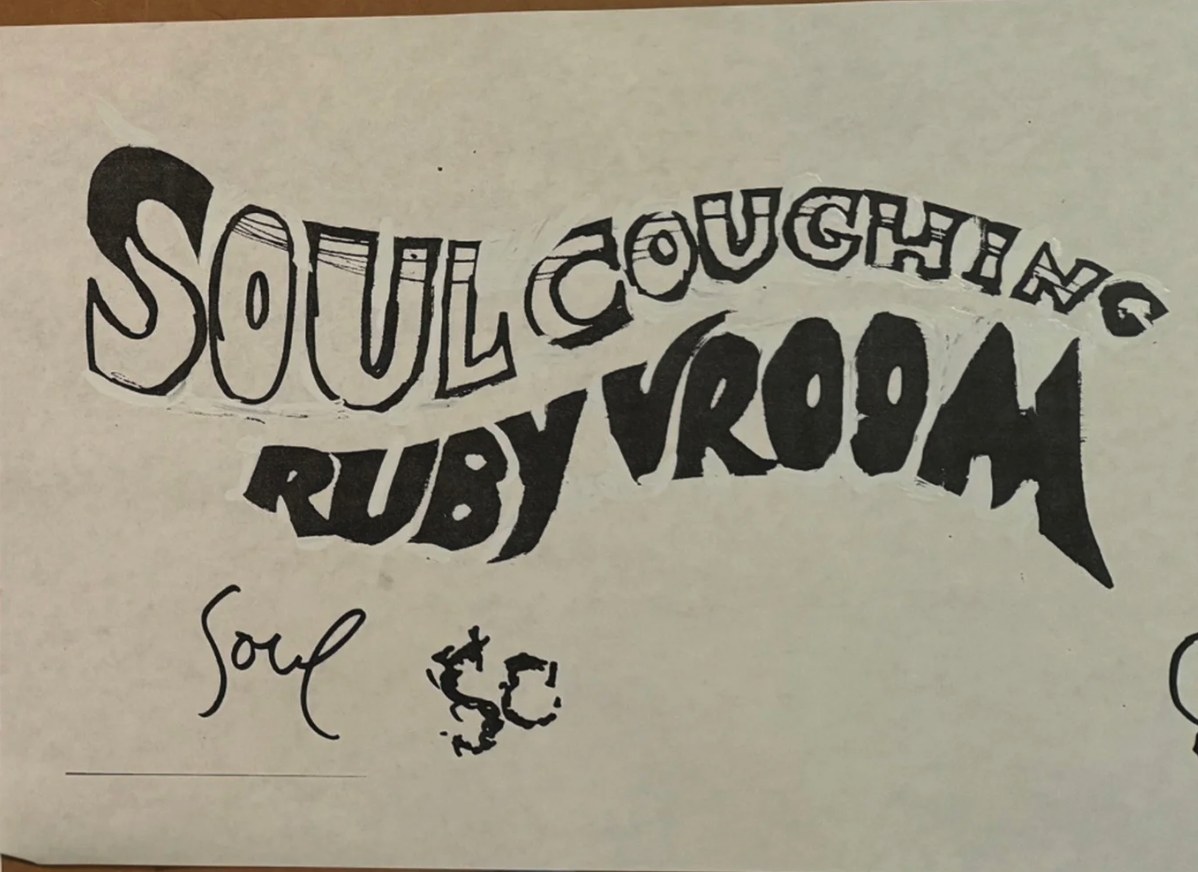
Ruby Froom, the young daughter of Mitchell Froom and Suzanne Vega, sometimes visited the studio. Gabay's accent turned "Ruby Froom" into "Ruby Vroom," and the band kept it.20 The girl on the cover is Kenndal Lynn Andrew, who was seven at the time. The image was a re-creation. Doughty said in 2016 that the cover was based on a still from one of Virginia Davis's "Alice" shorts for Walt Disney from the mid-1920s, the live-action girl in a cartoon world, devil included.21 The little devil in the artwork got his own moment later, when Warner ran a "Name That Funky Devil" contest. Doughty judged the entries and picked the winner, which read, in its entirety, "Stone Temple Pilots."
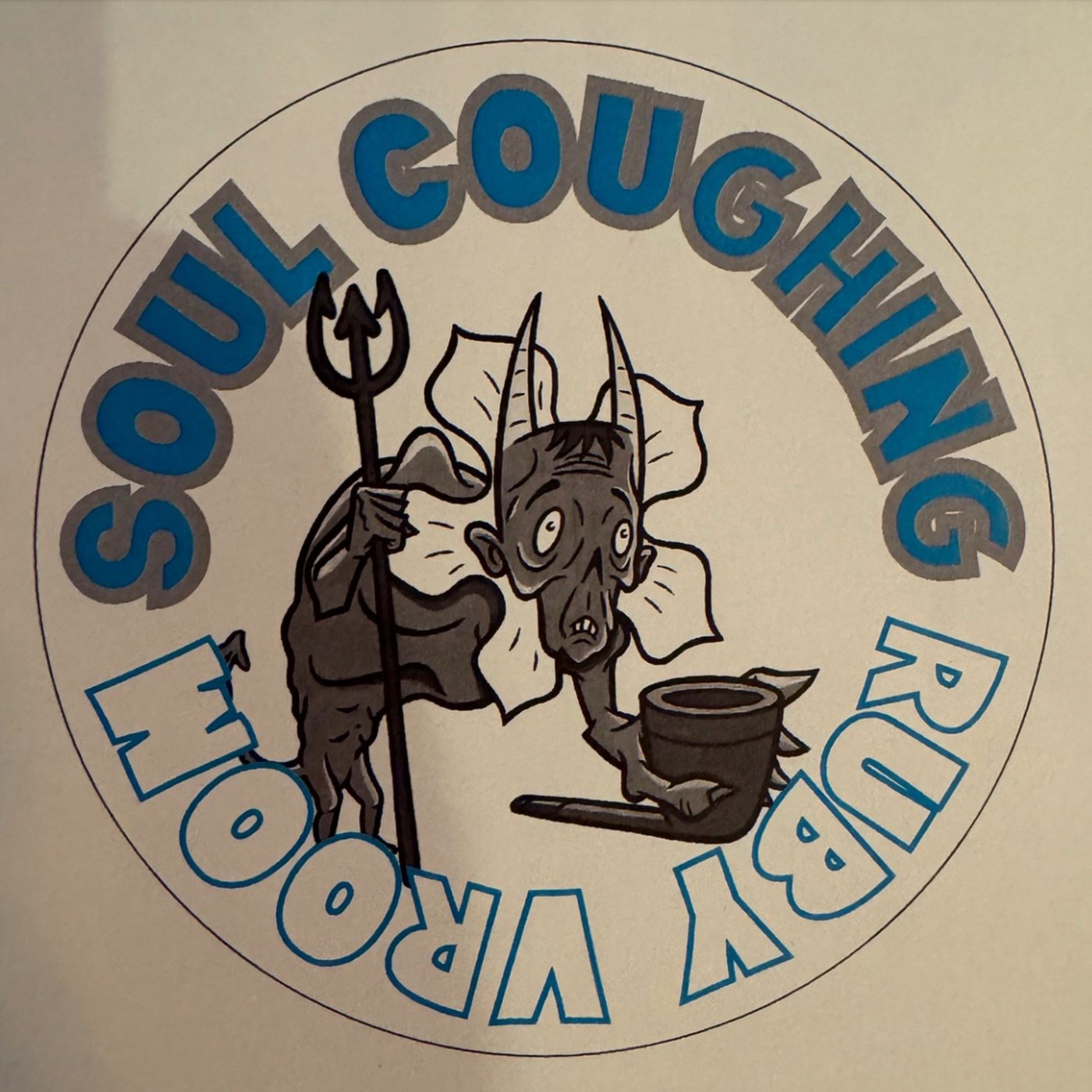
The package was art-directed by Kim Champagne, with illustration by Steve Wacksman, photography by Anthony Artiaga and band photos by Annalisa.7
Release and Reception
Doughty told the origin of "Down to This" on 120 Minutes in 1997. During a packed Meat Puppets show at the Knitting Factory, a photographer who sometimes covered the door while editing pictures took tickets while Doughty ran the guest list, with a Public Enemy track playing in the background. The back-and-forth, "you get the tickets and I'll get the list," was a little mantra to make the work less annoying, and it became the chorus.
The singles were "Down to This" (1994, video by Mark Kohr), "Sugar Free Jazz" (1995, also issued as a remix CD) and "Screenwriter's Blues" (1995, video by Jim McKay). None charted, but critics were enthusiastic. Entertainment Weekly gave it an A, Robert Christgau gave it an A, and Michael Azerrad's four-star Rolling Stone review credited degli Antoni with reinventing what a sampler could do as a rhythmic, harmonic and melodic instrument. AllMusic later called it one of the great debuts of the decade.12223
| Single | Year | US Alternative Peak | Video |
|---|---|---|---|
| "Down to This" | 1994 | Did not chart | Mark Kohr |
| "Sugar Free Jazz" | 1995 | Did not chart | None listed |
| "Screenwriter's Blues" | 1995 | Did not chart | Jim McKay |
Azerrad's review put them in a second wave of rap and rock, next to Beck and G. Love and Special Sauce, and argued they took it further, hearing everything from the O'Jays and William Burroughs to Benny Goodman's "Sing, Sing, Sing" in the mix.24 Christgau singled out the band's playing.25 Alternative Press joked that by the third listen you'd want five copies for your CD changer and then glue the tray shut, a line Slash was still printing on tour flyers the next spring. Looking back, AllMusic's Sean Westergaard called degli Antoni the band's secret weapon and said no sampler player in the decade since had come close.26 Low covered "Blueeyed Devil" in 1998.1623
Vibe, better known for hip hop and R&B, reviewed the record in October 1994. Suzanne McElfresh called Doughty "a rapper for the philosophical '90s," then added that Soul Coughing were really a groove band that worked in beats and rhymes, not a hip hop one. She singled out "Down to This," where a Toots and the Maytals riff, an Andrews Sisters snippet and Howlin' Wolf's "Smokestack Lightning" moan add up to "some kind of weird hoodoo."27
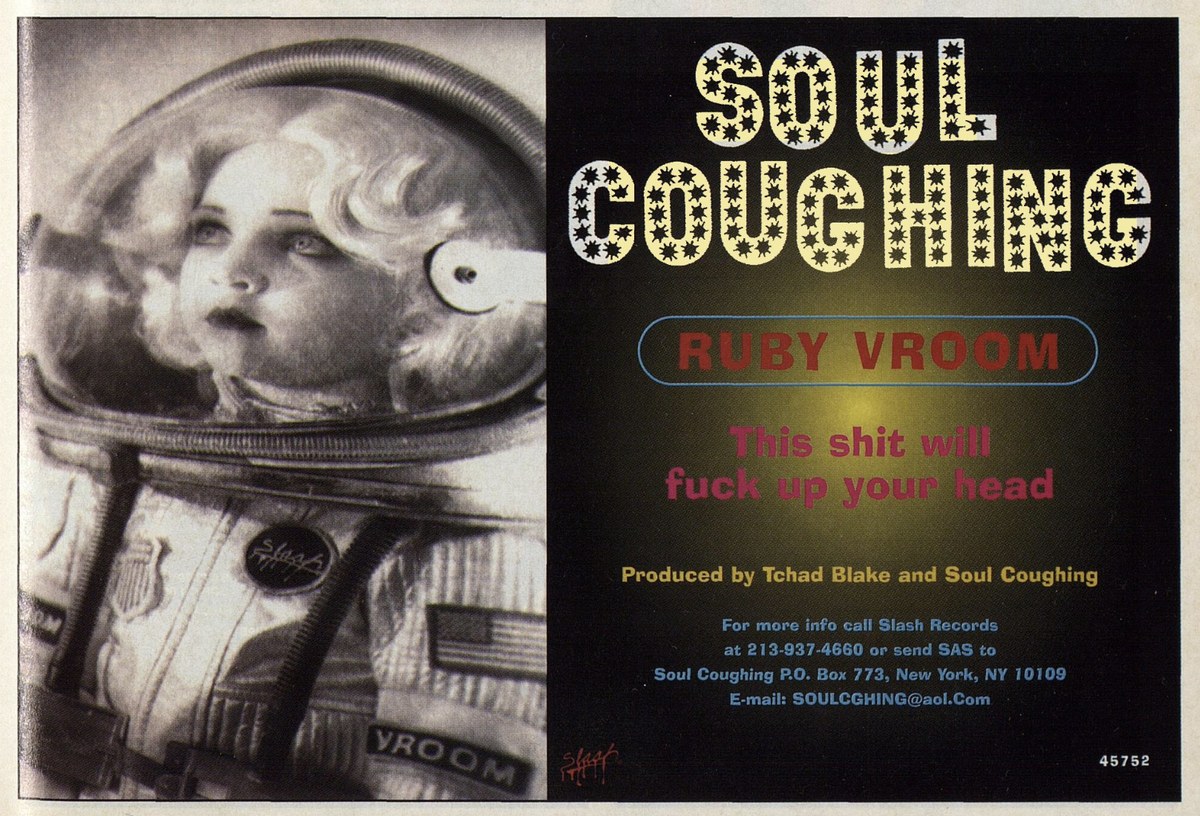
Slash's ads were out in force by then. Option ran a different one in September 1994, with a tag line that would not have worked in a Gap commercial: "This shit will fuck up your head." Fans were invited to write to a P.O. box in New York or email the band on AOL, at an address spelled SOULCGHING. Somebody at Slash had lost two letters on the way.28
Greg Kot caught them at Chicago's Lounge Ax in December 1994 and said a Soul Coughing set sounded like "several radio stations playing at once," with degli Antoni's effects supplying the seagulls, shortwave static and Andrews Sisters.29 A couple of months later he boiled it down to a dance party with a surprise every few minutes.30
The word spread on Usenet before radio caught up. On November 25, 1994, Hofstra student Dan Generosa posted a track-by-track rave to rec.music.reviews, opening with a groan about "another band with 'soul' in its name" before calling the record outstanding. "Is Chicago, Is Not Chicago" was "the first time i've danced around the room to poetry"; "Sugar Free Jazz" showed the band's "ability to make absolutely no sense lyrically but still sound amazing"; "Down to This" was "the Andrew Sisters meet Howlin' Wolf" and "must, must, MUST become a standard for dancehalls." He tagged "Blueeyed Devil" as the radio candidate ("so long as you don't mind references to the number of the beast"), found "Mr. Bitterness" misplaced, and signed off hoping the band would "make a whole lotta money and pay Ace of Base a couple mil to stop making records."1931
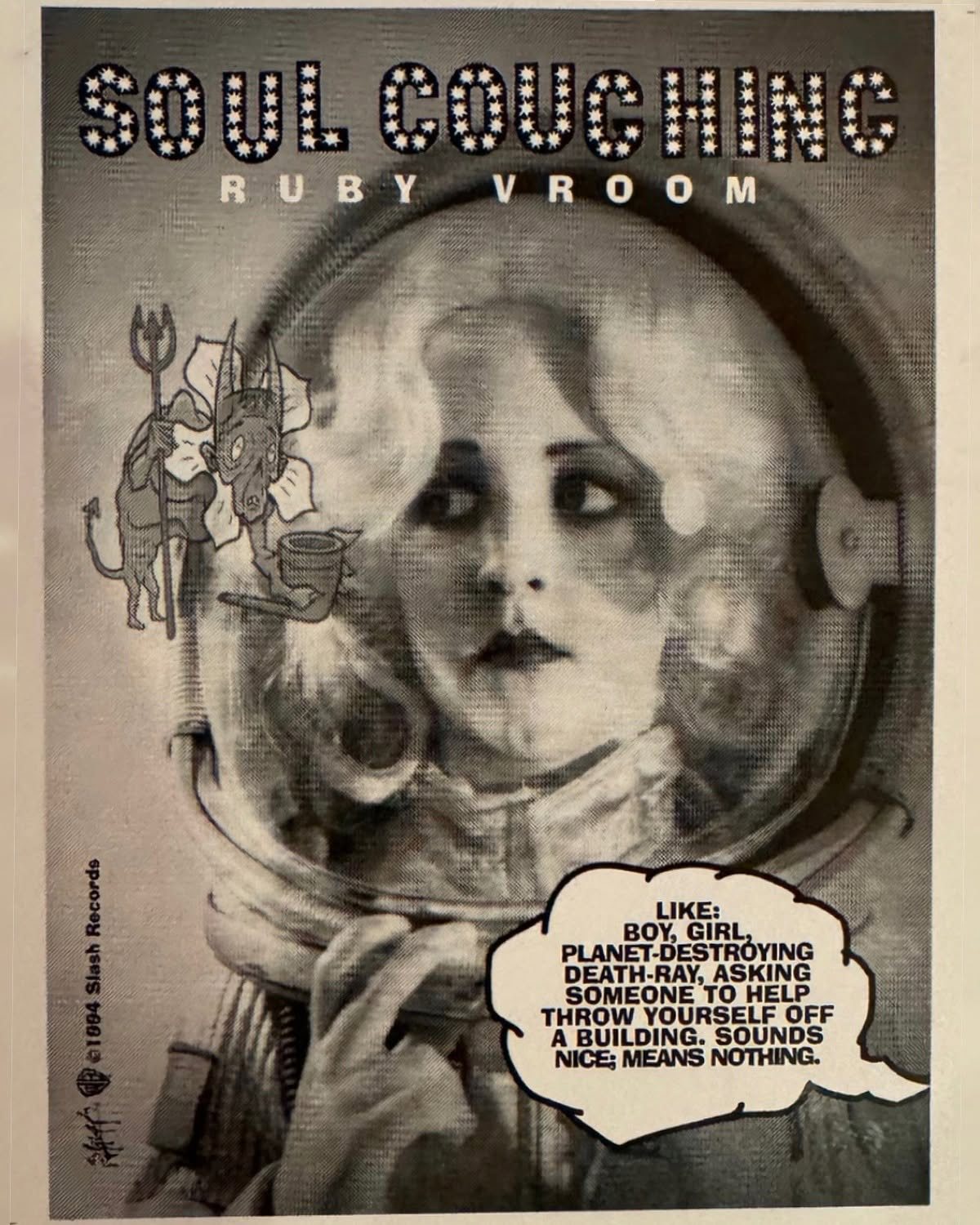
The ad's tag line came from Doughty's own description of his lyrics: words picked for how they sound, not what they mean.15
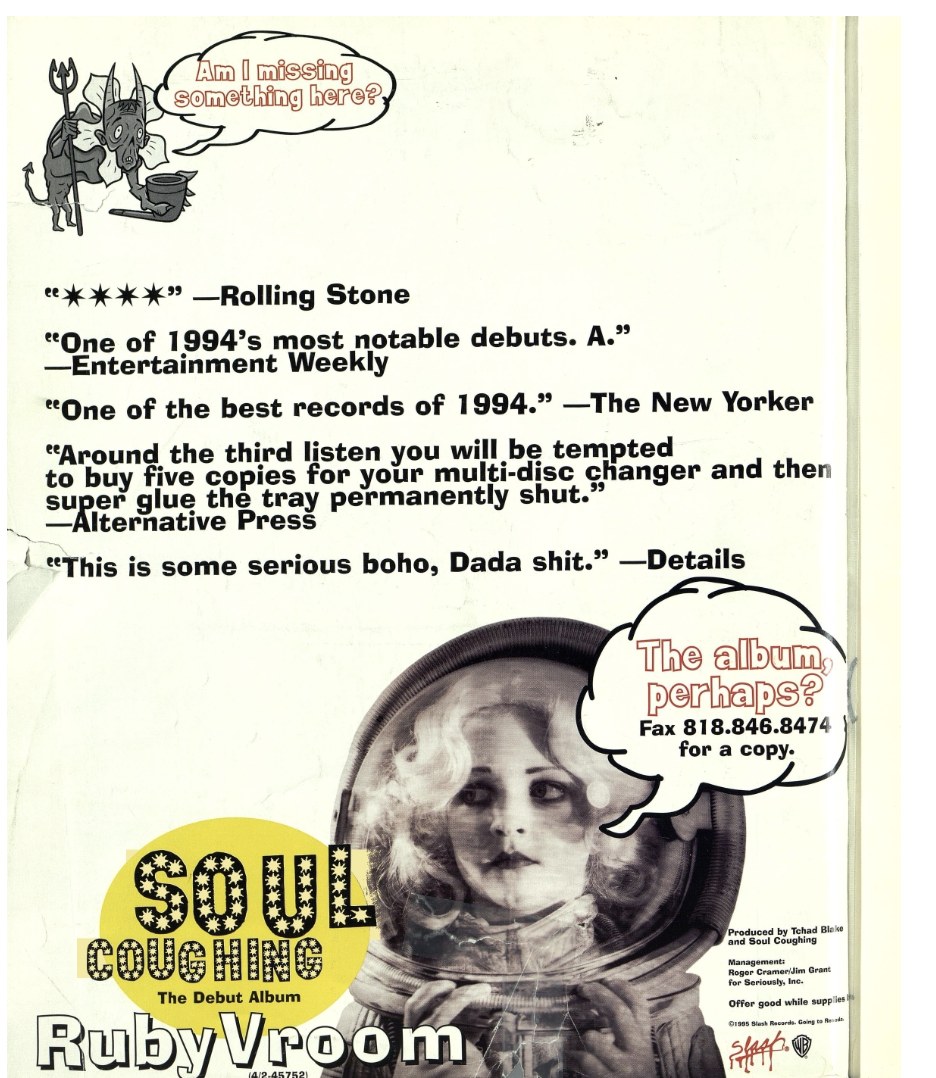
By February 1995 Slash was pitching the record to the trade. A full-page Billboard ad on February 25 lined up the reviews: four stars from Rolling Stone, an A from Entertainment Weekly, "one of the best records of 1994" from The New Yorker, "serious boho, Dada shit" from Details and the Alternative Press line about gluing the tray shut. A cartoon devil asks "Am I missing something here?" and a balloon over the cover girl answers, "The album, perhaps?" Even the devil wanted a copy. The fine print credits Tchad Blake and the band as producers and names Roger Cramer and Jim Grant of Seriously, Inc. as management.323313422
The phrase "Sugar Free Jazz" came from the Knitting Factory men's room wall, Doughty told StreetSound in 1995. Someone wrote "Free Jazz," someone added a drawing of Bert from Sesame Street behind bars captioned "Free Bert," someone else added "Free Drinks," and finally someone amended the first line to "Sugar Free Jazz." He admitted it was also a dig at the acid-jazz scene, which he and Gabay felt had found a formula and stopped searching. The 1995 Sugar Free Jazz promo EP carried the single plus two other mixes and a live remix of "Screenwriter's Blues," and Doughty said it was partly a stopgap while the second album was being finished.35
Sales were modest, and the number depends on who was counting. Phoenix New Times put it at about 85,000 in the US and 30,000 overseas in September 1995, Billboard reported roughly 70,000 by April 1996, and the 1998 label press bio claimed over 150,000. Nobody in the band pretended otherwise. Degli Antoni admitted the checks weren't fat, and when a Rolling Stone writer compared them to Talking Heads he waved it off: "We'll have to make four amazing records before we're the Nineties' Talking Heads."15 Doughty put it his own way: "We're not Green Day, but we're kind of kicking ass out there." He had started hearing the band on the radio while driving through Midwestern towns.936134
The album was never pressed on vinyl until Rhino's 180-gram reissue in 2015. A remastered 30th anniversary edition with era bonus tracks was announced on Jimmy Kimmel Live! in September 2024; the expanded track list includes "Buddha Rhubarb Butter," "Murder of Lawyers," "Amy Fisher," "Theme from Rachel's Sitcom" and the Mood Swing Mix of "Screenwriter's Blues."14
None of that was on anyone's mind in 1994. The band had a record out, a van waiting and a country full of rooms that had never heard of them.
-
Sebastian Steinberg interview, The Michigan Daily, March 13, 1995. ↩︎↩︎
-
Tchad Blake, interview with Chris Douridas, Morning Becomes Eclectic, KCRW, July 14, 1994. ↩︎↩︎
-
Wikipedia. ↩︎
-
Tchad Blake, Q&A on Gearspace (2007, reposted 2022). ↩︎↩︎
-
David Goggin, "Engineer/Producer Tchad Blake," Mix, February 1, 2005. ↩︎
-
Ruby Vroom CD credits, Slash/Warner Bros. 9 45752-2, 1994. ↩︎↩︎
-
"Soul Men," Houston Press, July 1996. ↩︎
-
Feature on Soul Coughing, Ray Gun, December 1994. ↩︎
-
Peter Howell, "Acid jazz, hip-hop & arcane references to Saskatoon," Toronto Star, March 9, 1995, p. H3. ↩︎
-
Margit Detweiler, "20 Questions: Sebastian Steinberg of Soul Coughing," Philadelphia City Paper, July 4, 1996. ↩︎
-
Band photo, Option, September 1994. ↩︎
-
Ruby Vroom 30th anniversary edition, Round Hill Records, 2024 to 2025; Record Store Day. ↩︎↩︎
-
"Slacker's Cough: Soul Coughing Gets Ill With Hip-Hop for Hepcats," Phoenix New Times, September 1995. ↩︎↩︎↩︎
-
WhoSampled, Ruby Vroom samples and covers. ↩︎↩︎
-
Mark degli Antoni, interview with SCUG, 1996. ↩︎
-
SonicNet chat with Doughty and degli Antoni, September 12, 1995, and SonicNet show coverage. ↩︎
-
alt.music.soulcoughing newsgroup, 1996 to 2013, via UsenetArchives.com. ↩︎↩︎
-
Soul Coughing FAQ, version 2.0, SCUG, May 2000. ↩︎
-
Mike Doughty (@Mike_Doughty_) on Twitter, June 27, 2016. ↩︎
-
Michael Azerrad, Ruby Vroom review, Rolling Stone, December 15, 1994, via Rock's Backpages. ↩︎
-
Robert Christgau, Consumer Guide. ↩︎
-
Sean Westergaard, Ruby Vroom review, AllMusic. ↩︎
-
Suzanne McElfresh, review of Ruby Vroom, Vibe, October 1, 1994, p. 119. ↩︎
-
Slash Records ad for Ruby Vroom, Option, September 1994, p. 105. ↩︎
-
Greg Kot, "3 Bands Let Lounge Ax See Future," Chicago Tribune, December 12, 1994, p. D16. ↩︎
-
Greg Kot, "Defying Categorization," Chicago Tribune, February 17, 1995. ↩︎
-
Dan Generosa, Ruby Vroom review, rec.music.reviews, November 25, 1994. ↩︎
-
Slash Records ad for Ruby Vroom, Billboard, February 25, 1995. ↩︎
-
Doughty interview, Details magazine. ↩︎
-
StreetSound interview with Doughty and Gabay, 1995. ↩︎
-
Soul Coughing, El Oso press biography, Slash/Warner Bros., 1998. ↩︎